
I used to think the worst outcome of a bad points transfer was losing the miles.
That did not happen to me. The Flying Blue miles I moved for a booking that never materialized remained in my account. I later used some toward a Vancouver-Mexico City award for our March 2027 trip, and I still have the rest to use.
But I did lose something less obvious: the ability to decide, later, which airline programme deserved those points.
That is a real cost. It just does not show up as a deduction on an account statement.
The booking that made the lesson personal
The story began when I found what appeared to be two China Airlines Business Class award seats from Vancouver to Taipei through Flying Blue. It was a routing I wanted, for two people, at a mileage price that made sense to me. So I transferred flexible bank points into Flying Blue.
The seats could not be booked. When I contacted Flying Blue, I was told that the availability had been phantom: the programme had never actually held those award seats. My request to reverse the transfer was refused.
I eventually found an alternative routing through another programme. And, as I said, the Flying Blue miles did not vanish. Some have already found a purpose in a later trip.
Still, the transfer had changed the nature of what I owned. Before it, I had transferable points and a choice of where to send them. After it, I had Flying Blue miles, subject to Flying Blue's award prices, rules and available flights.
That is the part of the story that matters here. The failed booking is its own lesson. This is about what happens after the points are committed.
Two consecutive dates. Two dramatically different award prices.
A screenshot from October 26, 2026 captures the problem far more clearly than two searches for flights months apart. I was looking at Air France's nonstop Business Class award from Vancouver to Paris. The date selector placed these options side by side:
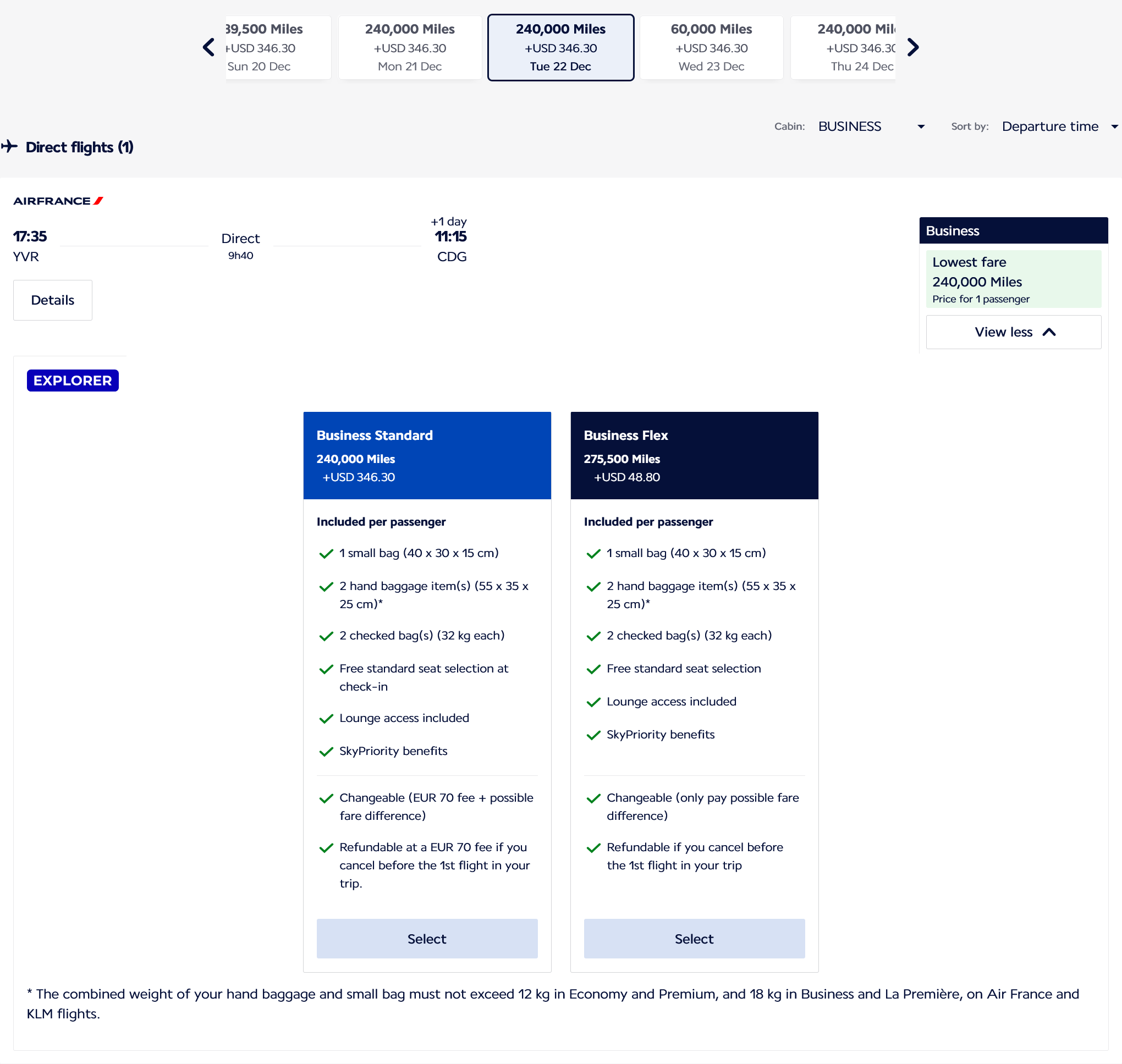
- Tuesday, December 22, 2026: the lowest Business reward was 240,000 Flying Blue miles, for a Business Standard fare, plus US$346.30 per passenger. The expanded fare panel showed no Business Light option.
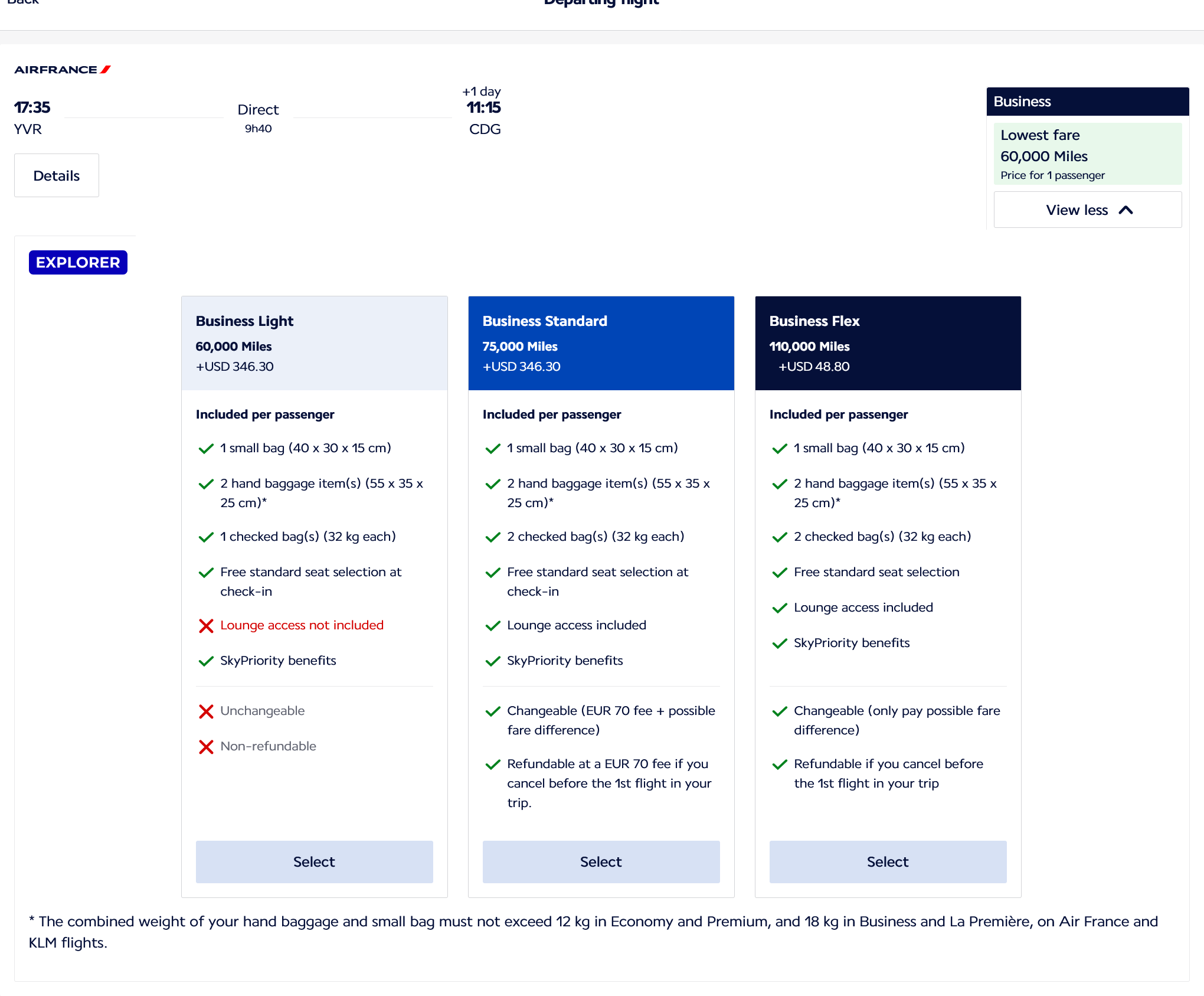
- Wednesday, December 23, 2026: just one calendar day later, the lowest reward was 60,000 miles, for Business Light, plus US$346.30. A Business Standard fare on December 23 was also visible at 75,000 miles, with the same US$346.30 charge.
The lowest available award was four times as expensive on December 22, even though the two departures were only one day apart. The date selector shows both prices in the same screenshot. That is the contrast I find difficult to plan around.
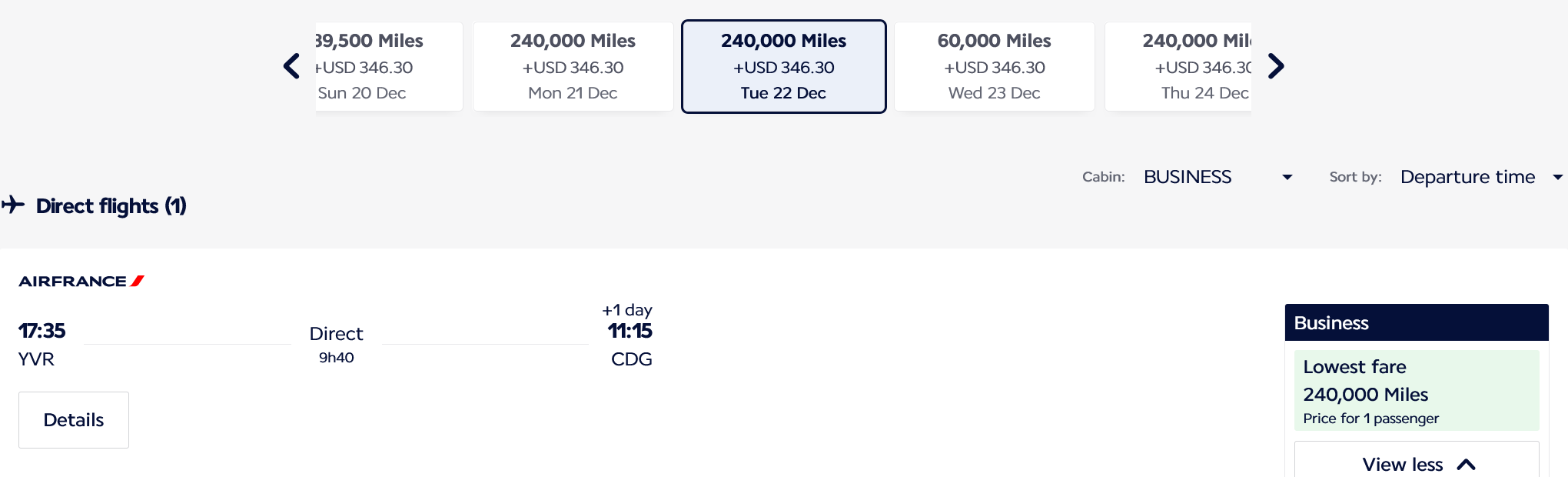
The difference cannot simply be described as one flight being searched much closer to departure than the other: both December dates were being viewed at essentially the same booking horizon. Nor does the screenshot tell me why the pricing changed so sharply. Inventory, demand and revenue-management choices can affect award prices, but the airline's underlying calculation is not visible to me. I cannot prove the prices are literally chosen at random; I can show that the resulting pattern is hard for a traveller to predict.
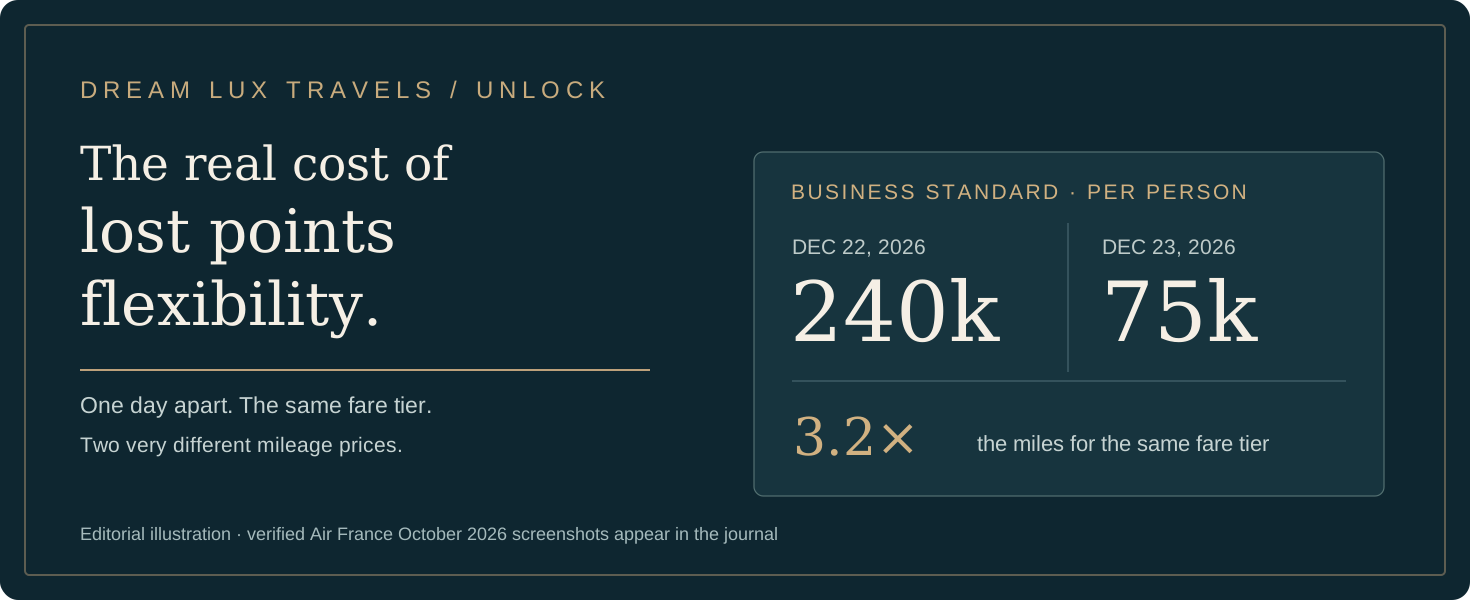
There is an important fare-brand qualification: 60,000 was Light on December 23, whereas 240,000 was Standard on December 22. Comparing those cheapest quotes is a useful minimum-cost comparison, not a like-for-like comparison of ticket conditions. Fortunately, the expanded screens let me compare the same fare tier. Business Standard cost 75,000 miles on December 23 versus 240,000 on December 22 — 3.2 times as many miles, or 165,000 extra, for flights one day apart.
These are award-search results for one passenger, not issued tickets or proof that two Business seats were bookable. The comparison does not prove historical devaluation, nor that every other date will behave the same way. It does show why choosing an award depends on the actual date you can travel, rather than a programme's attractive starting price or an assumption that booking early will produce a predictable cost.
If I can move my trip by one day, I might find a far more attractive award. But if I must fly on December 22 and my points are already in Flying Blue, I have to accept that programme's options or find a different use for those miles. If my bank points were still flexible, I could evaluate other eligible airline programmes, routings or cash fares before committing them.
The attractive fare exists. Just not necessarily on your date.
The earlier December 2026 award calendar gives the adjacent-date example additional context. December 23 and December 29 displayed 60,000 miles, while December 22 and many other dates displayed much higher quotes. This was one captured search, not a representative study of all Flying Blue award availability.
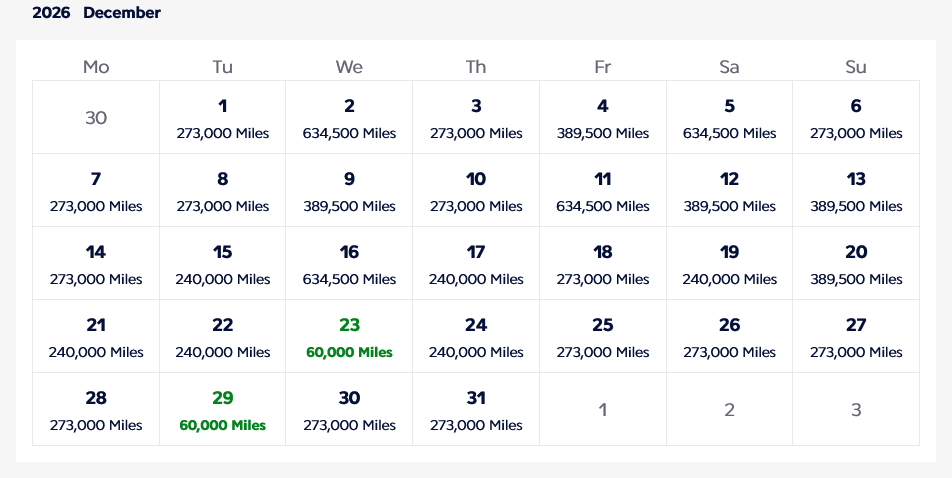
In other words, the 60,000-mile Business award had not disappeared. What I could not count on was finding it for the exact date and fare conditions I needed. I remember 60,000-mile West Coast-to-Europe Business awards being easier to find in the past, but I do not have a matched historical data series to quantify that change, and this article is not claiming one.
Planning ahead still matters. So does date flexibility. The one-day December contrast demonstrates why neither an advertised minimum nor a simple assumption about booking earlier is enough to plan a redemption around. Even then, a price displayed for one passenger does not guarantee two bookable seats for a couple.
Same route, but the fare tier changes what you get
A second form of flexibility matters: not every Business reward includes the same conditions. Since September 8, 2026, Flying Blue has offered Light, Standard and Flex reward fares on eligible Air France and KLM flights. The expanded booking screens I captured on October 26 show the actual prices for these consecutive December departure dates:
Swipe sideways to compare December 23 →
| Business reward, per passenger | Tuesday, December 22 | Wednesday, December 23 |
|---|---|---|
| Light | Not offered | 60,000 miles + US$346.30 |
| Standard | 240,000 miles + US$346.30 | 75,000 miles + US$346.30 |
| Flex | 275,500 miles + US$48.80 | 110,000 miles + US$48.80 |
On December 23, Light required the fewest miles. For my displayed Flying Blue Explorer status, however, it did not include lounge access and could not be changed or refunded. Standard, at 75,000 miles, included lounge access and additional baggage, with changes or refunds subject to the displayed EUR 70 fee and a possible fare difference. Flex offered broader flexibility and showed lower cash charges in these particular searches.
On December 22, Light wasn't offered. The cheapest reward was Standard at 240,000 miles, with Flex at 275,500. The numerical difference is striking even before considering fare benefits: Standard-to-Standard was 240,000 versus 75,000 miles on adjacent days.
The cash component is an additional reminder to inspect the complete ticket: both Flex quotes showed US$48.80, while the available Light/Standard quotes showed US$346.30. That does not mean Flex will always have lower cash charges. It means the true cost is the combination of miles, cash, restrictions, lounge access and cancellation conditions—not just one prominent number.
I do not know Air France's private pricing formula from these screenshots, and I would not describe the outcome as a statistically random process. What I can say is that the cost varied sharply between consecutive travel dates searched together, even for the same Standard tier. This illustrates unpredictable award pricing, not a before-and-after devaluation.
Why keeping bank points flexible is different
Before a transfer, the value of a flexible bank rewards balance is partly the range of possible uses: which airline partners are supported, what each one charges, and whether a workable award appears when you need it. That range depends on the bank and the particular card; not all transferable points offer the same choices or ratios.
After a transfer, the points become the airline's currency. They may be useful, sometimes exceptionally so, but they generally cannot be sent back to the bank for a do-over. American Express, for example, explicitly says that completed Membership Rewards transfers to airline programmes are irreversible.
The real comparison is therefore not simply:
75,000 versus 240,000 miles in Business Standard on two consecutive December departures, with 60,000 Light available on only the cheaper date.
It is:
A balance I can still allocate among eligible options versus a balance I have already committed to one programme.
That optionality has value even though it is difficult to assign a fixed cents-per-point figure to it. And it becomes more valuable when I am searching for two Business Class seats, have limited dates, or am trying to fit an award into a longer itinerary rather than inventing a trip to use up points.
I would rather leave some theoretical redemption value on the table than spend months trying to force a holiday around miles I moved too early.
What I would do differently
My approach now is to keep the flexible currency flexible for as long as it serves the trip.
I search for the exact number of travellers, cabin and flights I need, then compare available programmes and routings. I verify the current award cost, taxes, transfer ratio and expected transfer time. I look beyond the number of miles to the refund rules and other fare inclusions. Where partner availability looks questionable, I try to confirm it with the programme that will actually issue the ticket, knowing even a phone confirmation is not a guarantee that a seat will survive until ticketing.
Only after that do I decide whether the transfer is worth the risk. Sometimes it is: a genuinely bookable redemption can justify converting bank points into miles. Other times, retaining options is the better choice.
The practical lesson from my Flying Blue experience is not 'never transfer to Flying Blue.' I have used Flying Blue before and expect to use it again.
It is that miles retained and flexibility retained are two different things.
And until there is an award that works for our journey, I would rather own the second.