
I moved points into Flying Blue because two China Airlines Business Class award seats appeared available. But when I tried to book one using one account, the second seat disappeared from the other account. It never reappeared, even after I decided not to go ahead with issuing the first ticket. Flying Blue couldn't complete our intended two-person booking, and the points transfer could not be reversed.
That was frustrating. But the points themselves weren't lost. I later used some of the Flying Blue balance for our Vancouver–Mexico City trip in March 2027, and the remaining miles are being kept for another redemption.
It also reminded me of a less glamorous part of award travel: once points move into an airline programme, the clock attached to them can matter just as much as the redemption rate.
A balance that looks flexible on paper may come with a deadline—or a rule about what kind of activity actually restarts it.
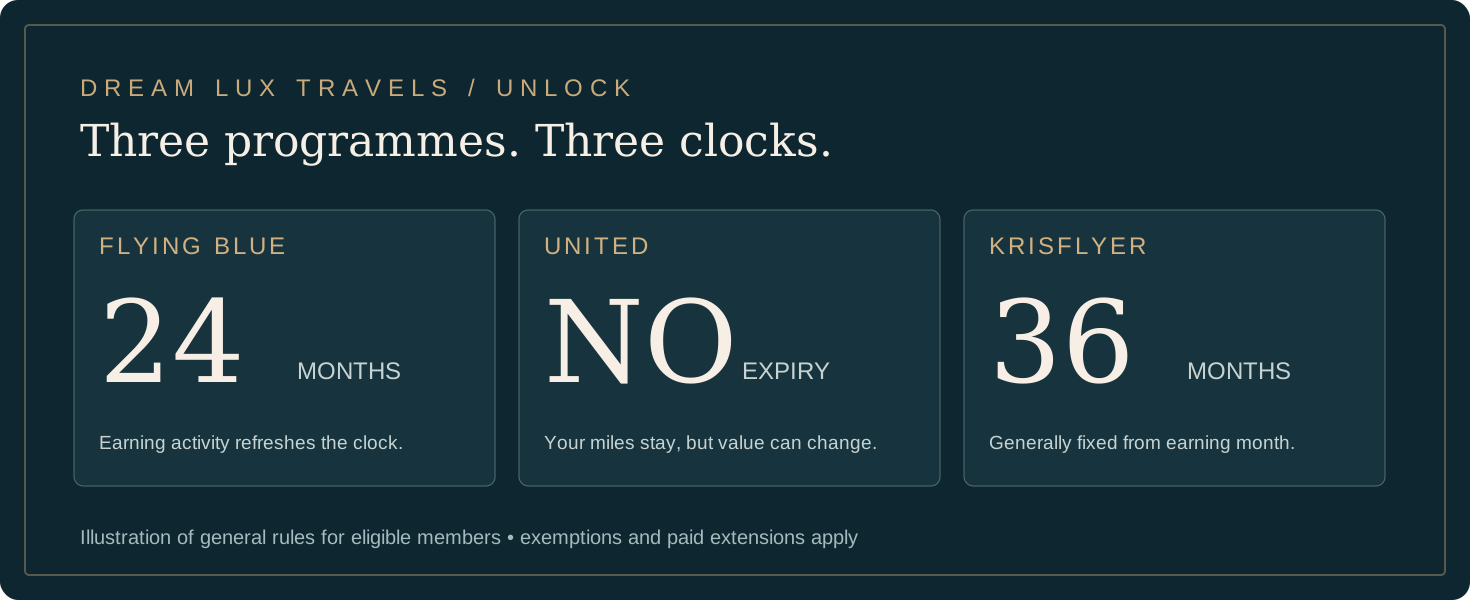
Three programmes. Three different rules.
For this comparison, I chose three programmes I have considered or used while planning trips: Flying Blue, United MileagePlus and Singapore Airlines KrisFlyer.
They offer a useful contrast, because the phrase “miles expire” means something different in each.
Flying Blue: a rolling 24-month clock
Since May 4, 2026, Flying Blue has applied a unified 24-month validity period for Explorer members aged 18 and over. Its updated rule says eligible earning activity extends the whole eligible miles balance for another 24 months, rather than maintaining separate validity dates for different types of miles.
That matters if you earn miles through more than flights. Eligible partner earning—including eligible transfers from bank rewards programmes—can help extend validity. But the distinction is earning activity; do not assume spending or simply booking an award automatically resets the clock.
There are important exceptions: eligible elite members, certain cobranded-card holders, Flying Blue Extra subscribers and minors can be exempt; Flying Blue also identifies separate arrangements in Germany. Always confirm the rule applying to your own account.
The current policy is genuinely more straightforward than Flying Blue's older rules.

United MileagePlus: no mileage expiry
United took a different approach. Under its current MileagePlus policy, award miles do not expire because of inactivity.
My United account page makes the point plainly: “Miles never expire.”
That phrase refers to balance expiry, not redemption value. A programme can change award pricing and availability even when it does not impose an inactivity deadline. Holding miles indefinitely and getting the same buying power indefinitely are not equivalent.

KrisFlyer: three years from when miles were earned
Singapore Airlines KrisFlyer works differently again.
For ordinary KrisFlyer, Elite Silver and Elite Gold members, miles generally expire three years after the month they were credited, according to the programme's terms. Earning new miles does not reset the expiration dates of older miles in the ordinary way.
That is a fixed clock, not a rolling one.
There is a limited safety valve: expiring miles can generally be extended once for a fee, if action is taken before they expire. Singapore Airlines currently lists US$12 or 1,200 KrisFlyer miles per 10,000 miles (or part thereof) being extended. The extension is six months for standard KrisFlyer members or 12 months for Elite Silver and Elite Gold. PPS Club has different non-expiry rules, and promotional miles may have separate restrictions.
The ability to pay for a short extension doesn't make a speculative transfer harmless.
The mistake I try to avoid
A search may make a transfer seem obvious. The award appears, the price works, and the points can be moved to the airline. But those aren't three independent guarantees.
The seats may fail at ticketing, as I learned with Flying Blue. The transferred points may then be locked into the airline programme. And the mileage balance may be subject to an expiry rule—or may lose purchasing power even without an expiration date.
Before I move flexible bank rewards, I want to know four things: the ticket is genuinely available; the transfer will arrive in time; the miles will have a useful life if the booking fails; and the programme's award rules make sense for our plans.
I don't see this as an argument against airline miles. Some of our best journeys have come from using them.
It's an argument for not confusing a points balance with cash in a bank account.
What I'd do differently
I would verify as much as possible before transferring. For fixed-expiry programmes, I would be particularly reluctant to move a large speculative balance without a concrete use.
For a programme like United, I wouldn't worry about an inactivity expiry date—but I'd still remember that award prices and inventory can change. For Flying Blue, I'd confirm which earning activities qualify under the new rule rather than assume every transaction keeps miles alive. For KrisFlyer, I'd note the date each block of miles was earned and the cost of any available extension.
The best points strategy isn't always the one that earns the most miles.
Sometimes it's the one that preserves the most options until you're actually ready to travel.
Programme rules & sources
Policy details checked in November 2026. Terms, elite status and eligible earning rules can change; check your own account before transferring.