
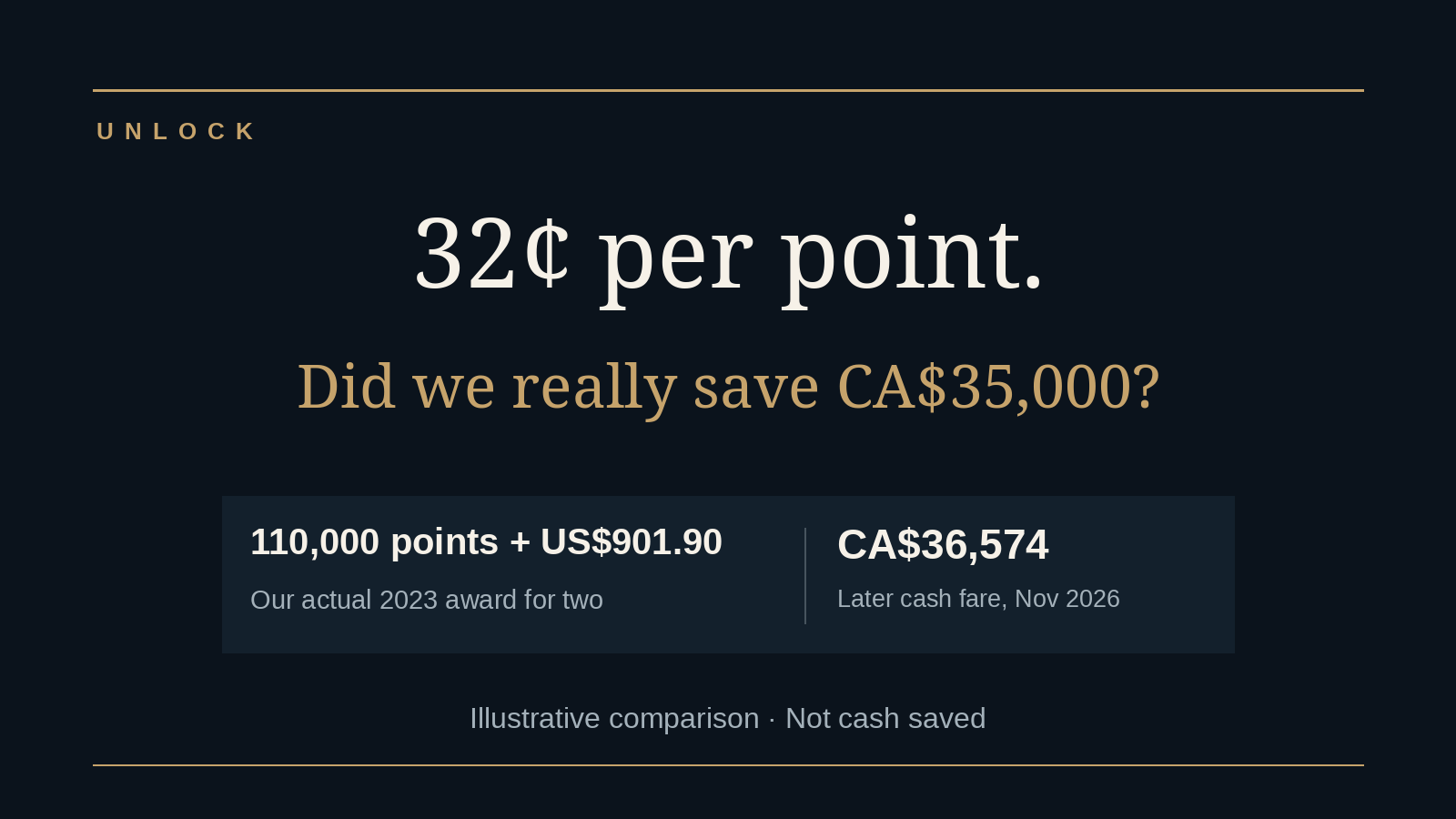
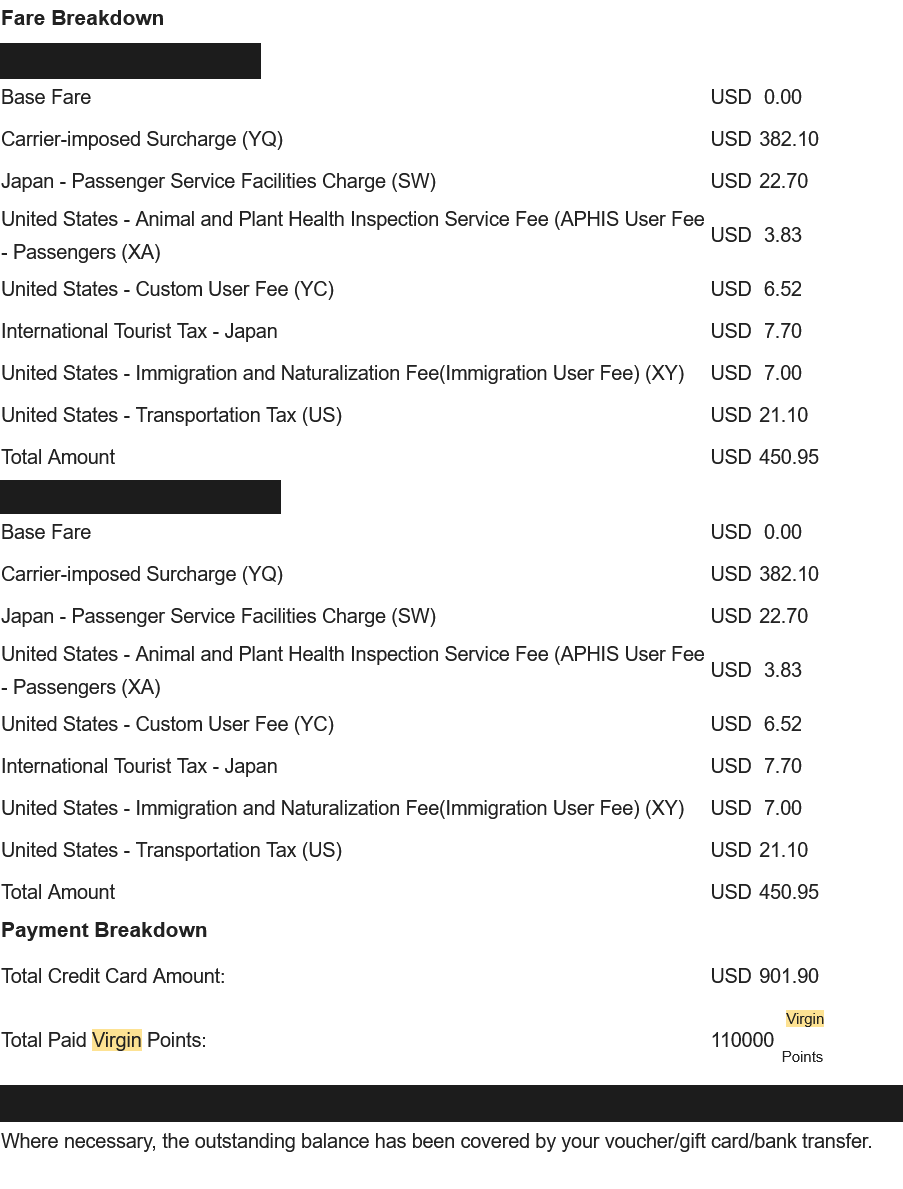
When we flew ANA First Class from Tokyo Haneda to San Francisco in July 2023, we used 110,000 Virgin points and paid US$901.90 in taxes and fees for two people.
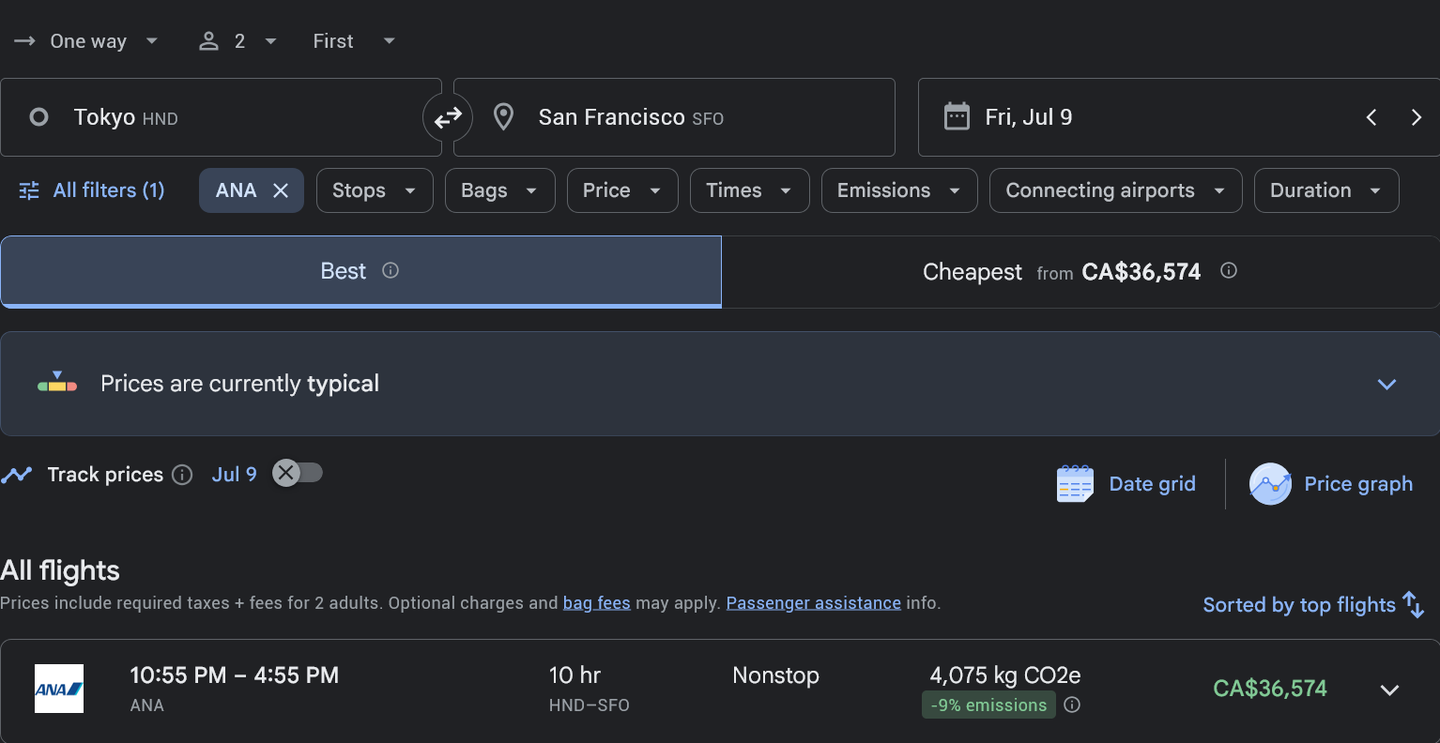
In November 2026, we looked up a comparable ANA First Class flight on the same route. The price for two adults, one way, was CA$36,574.
On paper, that comparison puts our redemption at more than 32 Canadian cents per Virgin point. It is the sort of number that makes a points redemption look extraordinary.
And it was extraordinary. But we would never have paid that cash fare. So did we really save CA$35,000?
No. We unlocked an experience we wanted without paying its retail price. That is a different—and, to us, more meaningful—achievement.
What cents per point actually measures
Cents per point (CPP) is a way of comparing the cash price of a travel experience with the number of points required to book it. The standard calculation is straightforward:
Headline CPP = (comparable cash price − cash paid on the award) ÷ points used × 100
Use the same currency throughout. For example, a CA$1,000 fare booked with 40,000 points plus CA$200 produces 2 Canadian cents per point.
The calculation itself is not the problem. The problem starts when we turn that result into a claim about how much money we saved.
Our ANA example: impressive on paper
The award receipt for our July 2023 trip shows 110,000 Virgin points and US$901.90 paid for two travellers. Of that cash amount, US$764.20 was carrier-imposed surcharges; US$137.70 was other taxes and fees. It was not a free flight.
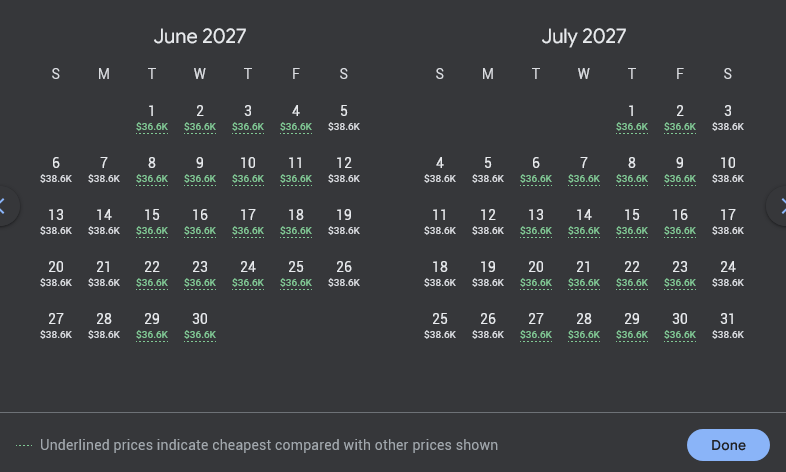
Our Google Flights search on November 24, 2026 showed CA$36,574 for two adults in ANA First Class, nonstop from Haneda to San Francisco on July 9, 2027. The accompanying June–July calendar showed multiple dates around CA$36,600. These were later search results, not the cash fare available when we booked in 2023.
For an illustrative comparison in Canadian dollars, convert the award's US$901.90 using the Bank of Canada's November 24, 2026 indicative rate of CA$1.4296 per US dollar. That is CA$1,289.36—not a reconstruction of our original card statement.
(CA$36,574 − CA$1,289.36) ÷ 110,000 × 100 = 32.08 Canadian cents per Virgin point
That tells us the scale of the difference between the later observed First Class fare and our historical award cost. It does not establish that the same award was available in 2026 or 2027, that the 2023 cash fare was the same, or that we avoided spending CA$35,284.64.
We loved the private suite and the hospitality, and we would make that redemption again. We would not have paid the retail First Class price. If you want to know whether the experience itself was worth it, our ANA First Class review explores what we liked and what disappointed us.
Start with the ticket you would actually buy
Imagine that, instead of redeeming points, two travellers would realistically buy a CA$4,000 cash itinerary. This is a hypothetical budget, not our historical alternative fare.
Against the same illustrative CA$1,289.36 award charge, the cash outlay avoided would be CA$2,710.64—not CA$35,284.64. Spending 110,000 points to avoid that outlay is equivalent to 2.46 Canadian cents per point on a cash-alternative basis.
If the alternative were Business Class, Premium Economy or a different itinerary, it would not necessarily provide the same comfort, timing or experience. The cash comparison and the value of the upgrade are distinct questions. If the alternative were not travelling at all, the award would involve new spending rather than displacing an airfare purchase.
There is no need to diminish the value of travelling in First Class. It simply belongs in the experience side of the decision rather than an invented cash-savings figure.
What would you be willing to pay for the experience?
This is where we find a more useful personal decision metric. Before looking at a headline CPP, decide how much cash you would genuinely be comfortable paying for the award experience itself. Subtract the award's cash charges, then divide by the number of points required.
Personal effective CPP = (your genuine willingness to pay for the experience − award cash charges) ÷ points used × 100
It is an implied personal value ceiling for those points in this decision, not a market quote or literal cash saving. Compare it with what those points could unlock elsewhere, or with their realistic acquisition cost. A redemption can have a spectacular headline CPP and still be a poor choice if it consumes points you need for something more important.
Conversely, a lower headline CPP may be exactly the right redemption if it avoids a cash expense you would otherwise incur, gives you a better itinerary, or makes a trip possible within your budget.
The comparison can change before you even book
Cash prices change with dates, route, cabin, fare rules and availability. Award prices and availability can change too. Premium-cabin one-way fares also need not be half the price of a return ticket. Comparing a one-way award with an arbitrarily divided return fare can distort the result.
Look at the whole itinerary and the actual alternatives: a cash ticket may earn airline miles, credit card rewards or qualifying credit, depending on its fare and program. An award may have different earning, change and cancellation rules. Some programs permit useful stopovers or additional destinations, while others charge extra points or fees. A transfer can also tie up flexible points in a specific program.
None of these factors has a universal value. But all can change which booking is actually better for you. Compare like with like where possible, and explicitly account for differences when you cannot.
The questions we would ask before transferring points
- What would we actually book and pay if points were unavailable?
- What extra value do we personally place on this cabin, hotel or itinerary?
- How much cash will the award still cost, including taxes and surcharges?
- What else could we do with the points, and what would we give up by using or transferring them now?
- Is the award really available, and do its dates, conditions and itinerary work for us?
Use headline CPP as one comparison, not the verdict. Our travel rewards glossary explains CPP and the other terms that matter when evaluating an award.
Travel is the point
The reason we collect points is to make travel possible, more comfortable or more memorable—not to produce the largest theoretical savings figure.
ANA First Class was a wonderful use of our points because it unlocked an experience we wanted but would not have purchased at retail. The 32-cent comparison illustrates why the redemption was exciting. It is not the reason we enjoyed the flight.
A good redemption is not necessarily the one with the highest CPP. It is the one that makes sense for the trip you want, the money you would spend and the points you have.