
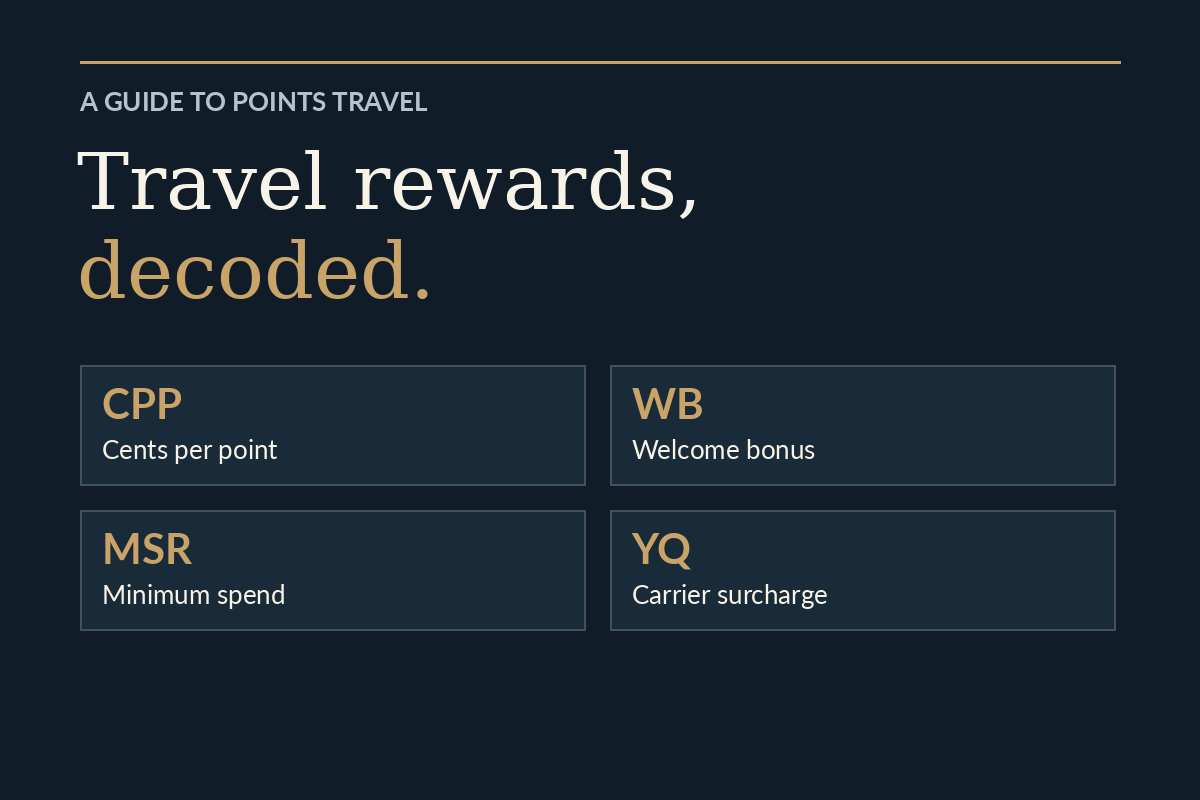
The language of points travel shouldn't be a barrier to experiencing it
Spend a little time reading about travel rewards and you will probably encounter a conversation that sounds something like this: a good WB, a high CPP, an MSR to meet, and two J seats to find.
Each abbreviation is useful when you already know what it means. Together, they can make an otherwise simple decision feel unnecessarily complicated.
When we plan a trip, the questions we care about are straightforward. What does the booking cost? What experience are we getting? Which conditions could change the outcome? The terminology is useful only insofar as it helps us answer those questions.
This is the reference I would want someone to have beside them when reading a credit-card offer, searching for an award flight or checking an itinerary. It is not a list of ways to earn the most points. It is a guide to understanding what you are actually being offered.
The numbers behind a redemption
Points and miles. A reward currency earned or held in a particular programme. The word "mile" does not necessarily represent a physical mile flown. One airline's miles and another airline's points cannot be treated as the same currency simply because the balances are identical.
Transferable points. Some bank rewards can be converted into airline miles or hotel points. The available partners, eligible products, transfer ratios and processing times depend on the rewards programme. An airline balance is different from a flexible bank balance; a completed transfer may be irreversible.
Transfer ratio. The relationship between the points sent and the rewards received. A 1:1 conversion of 1,000 bank points produces 1,000 destination points. A 4:3 conversion of 4,000 produces 3,000. These are illustrative ratios, not current offers. Check the direction of the ratio, minimum increments and any other conditions before transferring.
Award or redemption. A booking made using a loyalty programme's points, miles or eligible certificates. It can still require cash payments. The loyalty programme through which a flight is booked may differ from the airline operating it.
CPP — cents per point
CPP is a common way of expressing the cash value represented by a particular redemption. Start with a comparable cash price, subtract the cash you would still pay on the award, divide by the number of points used, and multiply by 100.
CPP = (comparable cash price − cash required for the award) ÷ points redeemed × 100
For example, imagine the same flight and comparable fare conditions cost CA$1,000 in cash or 40,000 points plus CA$200. The redemption offsets CA$800 of the reference price. CA$800 divided by 40,000 points is CA$0.02 per point: 2 Canadian cents per point.
This is an illustrative calculation, not one of our bookings or a live award quote. For a meaningful comparison, use the same currency, passenger count, routing, cabin and comparable fare conditions. Include the applicable award cash charges. Do not compare a two-person cash fare with a one-person award or subtract a US-dollar charge directly from a Canadian-dollar fare without converting it.
CPP is not a fixed exchange rate for a loyalty currency, and the result is not necessarily what you personally saved. A cash price you would never have paid is still a reference price, not automatically an avoided expense. That distinction deserves its own article; for now, the important thing is to understand what the calculation measures.
The language of flights
Y, PY, J and F. These are widely used informal shorthand in points-travel conversations for Economy, Premium Economy, Business and First Class, respectively. They describe the broad cabin someone is discussing. Not every airline offers every cabin.
Booking class (or reservation booking designator). A letter assigned to a fare or inventory bucket on an airline. It is more specific than a broad cabin label. There may be several booking classes within one cabin, and a letter may mean something different on another airline. The full fare basis is a separate code that can encode further fare details.
For instance, ANA's published international boarding-point table lists F and A under First, J/C/D/Z/P under Business, G/E/N under Premium Economy, and multiple Economy classes including Y and W. That is an example of the airline's own published classification, not the booking class on our particular ticket or a universal list of fare letters. The letter W is often associated with Premium Economy elsewhere, but appears in ANA's Economy list. Always read the carrier's own classification and the applicable fare rules.
Fare brand. A marketed bundle of conditions, such as a basic or flexible fare. Two passengers in the same cabin might have different baggage allowances, change conditions or earning rates. The cabin alone does not establish what a ticket includes.
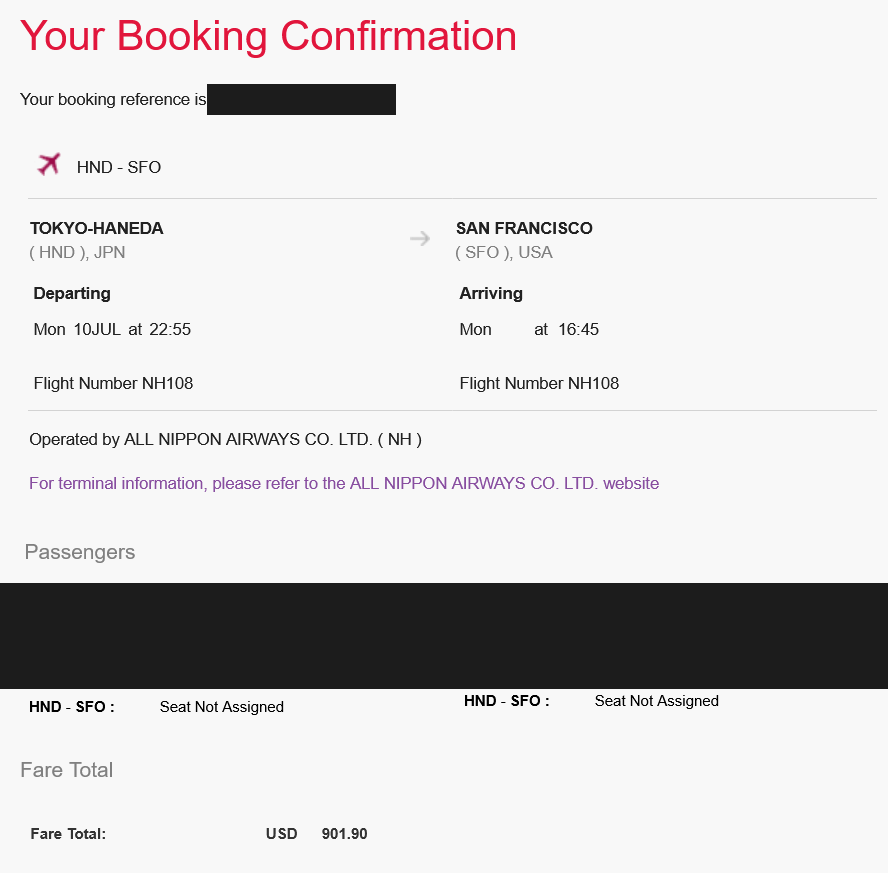
Operating airline versus booking programme. The carrier flying the aircraft is not necessarily the programme through which you paid with points. Our Virgin Atlantic booking confirmation identifies NH108 from Tokyo Haneda to San Francisco and lists All Nippon Airways as the operating airline. The accompanying fare breakdown records 110,000 Virgin points and US$901.90 for two travellers. The flight number tells us who operates the flight; the payment breakdown tells us which programme we used and what we paid. Neither extract identifies a booking class, and the itinerary does not itself identify the cabin.
Partner award. A redemption booked through one programme on a flight operated by another airline that participates in its redemption network. Partnership does not guarantee that a particular seat is available, at a particular price, or for everyone travelling together. Our same-flight comparison illustrates why the programme through which you search matters.
Award availability. The seats or rooms offered for redemption through the programme you are using, under the relevant rules. Seeing a cash seat or a published award chart does not establish that the award can be ticketed. We learned this firsthand when a promising partner-award search failed to become a booking for both of us.
Reading a card offer before you commit
WB — welcome bonus. Extra rewards offered to eligible new cardholders who satisfy an offer's conditions. An advertised maximum can combine several separate milestones. Check who qualifies, the amount of eligible spending, the timing, and whether the account must remain open and in good standing. In aviation discussions, WB can also mean widebody; the context matters.
AF — annual fee. The fee charged for holding a card for a year, according to the issuer's terms. It is a real cost, even when the card provides credits or benefits. When deciding whether the card is worthwhile, consider benefits you would actually use and costs you would actually incur. AF also identifies Air France in an airline-code context.
MSR — minimum spend requirement. The eligible spending threshold you must meet within the stated time to qualify for a particular offer. The exact definition of eligible spending, treatment of refunds and posting deadlines are issuer-specific. A purchase initiated before the deadline may not satisfy an offer that requires it to have posted by then. Spend you would not otherwise incur and interest or fees can undermine the value of a bonus.
One advertised bonus, two milestones
The public Canadian American Express Platinum Card offer reviewed on 24 November 2026 provides a useful example of the language in practice. The issuer's product page advertised 70,000 Membership Rewards points after CA$10,000 of spending in the first three months, and another 30,000 after a qualifying purchase in months 15–17. Its listed annual fee was CA$799. The detailed terms specified net purchases posted to the account for the first threshold, and a purchase charged within the later window and subsequently posted for the second. Eligibility and account-standing conditions also applied.
The headline total of 100,000 points therefore was not one reward paid automatically on approval, nor was it all earned by reaching the initial spending threshold. There were two conditions on different timelines and a separate annual cost to evaluate. This is why I read the full offer terms, not just the largest number on the page.
This is a dated public-offer example, not a claim about our personal card or an invitation to apply. Offers and fees can change, including between channels. Check the issuer's current offer and its terms before making any decision. We don't recommend changing your spending solely to earn a bonus.
FNC — free-night certificate. A certificate that can be redeemed for an eligible hotel night under a programme's particular conditions. Some have limits on the hotels, award availability, expiry or permitted points top-ups. Unlike a general points balance, a certificate ordinarily has specific restrictions; it also does not mean all costs of the stay disappear.
Why a points ticket can still require cash
Taxes, fees and carrier-imposed charges. These are components of the cash portion of an award. Government or airport taxes and airline-imposed charges are not the same thing. Some programmes also charge their own booking or servicing fees.
YQ and YR. Ticketing codes used for carrier-imposed surcharges, which may appear in the ticket's tax/fee breakdown. Some are described as fuel or other surcharges. They are not simply government taxes because of where they appear. The amount collected depends on the itinerary, airline and booking programme.
One of our historical ANA awards, booked through Virgin Atlantic, makes this distinction particularly clear. For each of us, the base fare shown in the cash breakdown was US$0, but the carrier-imposed surcharge (YQ) was US$382.10. Government and airport taxes and fees accounted for another US$68.85. The cash total was US$450.95 per person, alongside the points used.
| Our historical ANA award | Per traveller | Two travellers |
|---|---|---|
| Virgin points | 55,000 | 110,000 |
| Carrier-imposed surcharge (YQ) | US$382.10 | US$764.20 |
| Other taxes and fees | US$68.85 | US$137.70 |
| Total cash paid | US$450.95 | US$901.90 |
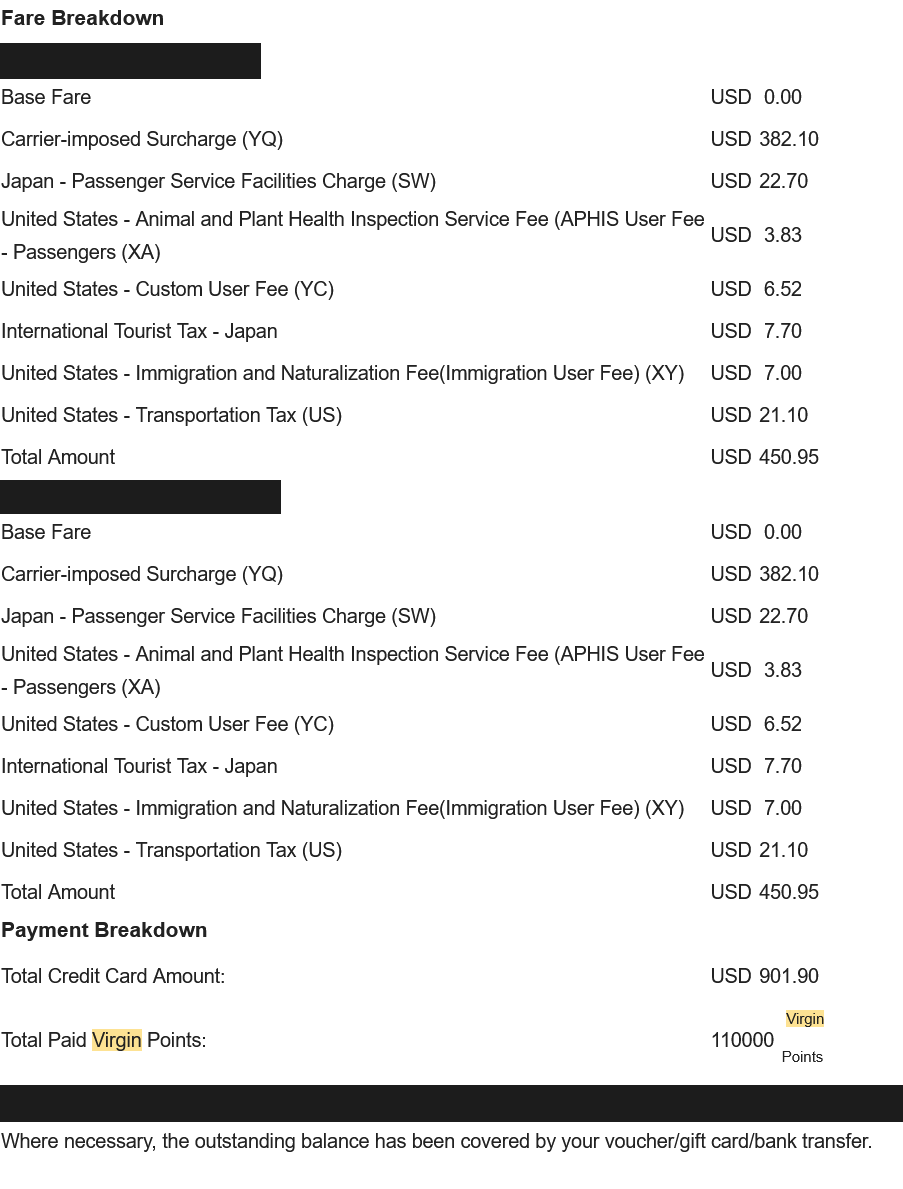
This is the actual payment breakdown, not an example of what the award would cost today. A zero cash base fare did not make the ticket free.
Two awards that require the same number of points can therefore have substantially different total costs. Before committing, read the cash total, currency, passenger count and fare conditions on the actual checkout page. For CPP, use the full relevant cash amount payable on the award—not only a line described as tax.
The shape of a trip
OW — one-way. A journey from an origin to a destination without a booked return on that itinerary.
RT — round-trip. An itinerary that includes travel out and back. The fare rules and award pricing determine how it is constructed; it does not necessarily cost exactly twice a one-way booking.
Open-jaw. An itinerary whose outbound destination and return origin differ, or whose departure and final return cities differ. For example, flying from Vancouver to Rome and returning from Paris to Vancouver leaves a segment between Rome and Paris for you to arrange. This is an illustrative routing, not a claim about one of our bookings.
Connection or layover. An interval between flights. An airport change, separate tickets, bags or immigration can change how practical it is. The maximum time treated as a connection varies according to the programme and itinerary.
Stopover. A permitted longer interruption in the journey before continuing to the destination, subject to the programme's pricing and routing rules. Some programmes permit a stopover within a one-way itinerary; others have different rules. Don't assume every long connection qualifies or that a stopover is free. In our five-stopover journal, adding actual stays in places such as Taipei, Switzerland, Warsaw and El Salvador changed the experience of our trips. That was the value of understanding the booking structure, not just the number of points involved.
Positioning flight. A flight used to get to the airport from which the main journey departs, or onward after the main journey ends. It may be on a separate ticket, with separate baggage and disruption risks. Include its cost and the time and protection it requires when comparing a redemption with a more direct alternative.
A few questions worth asking every time
Before transferring points, opening a card for its rewards or booking an award, I would want to understand the answer to five questions:
- Which programme will hold the rewards, and what can those rewards actually book?
- What is the total cost in points and cash, for everyone travelling?
- What are the cabin, actual operating airline and fare conditions on each segment?
- What must happen for the offer or redemption to become real, and by when?
- If something changes, can we still make the trip work?
Knowing the abbreviations helps. Knowing what they mean for the trip is what matters.
Dream Lux Travels is about using rewards and thoughtful planning to make experiences possible, not about collecting the most acronyms or the highest headline redemption value. Save this guide for the next time a search result or an offer raises a question.
References (public source checks, 24 November 2026)
- American Express Canada, The Platinum Card product offer and detailed Membership Rewards card offer terms. Dated example; offers and fees can change.
- ANA, Premium Points and international booking classes and international fare options. Airline-specific examples, not the booking class on our historical NH108 ticket.
- Travelport, YQ and YR surcharges.
- Virgin Atlantic, reward flights and charges. Availability on Virgin Atlantic-operated flights does not establish availability on all partner flights.
- Air Canada, Aeroplan Flight Reward Policy. The stopover stays are historical examples, not a current price promise.